Search This Blog

Saturday, August 26, 2017

Die Fahne hoch!

Someone recently asked me if Horst Wessel’s rousing Die Fahne hoch! could be considered a spiritual song. It was the Nazi anthem from 1930 until 1945. Promising an imminent end to “servitude” and “a day freedom and bread,” it became the stirring battle hymn of a desperate people. Singing it, they emerged from the smoldering ash heap of defeat to ignite a conflagration across Europe and North Africa.
The Third Reich itself was a spiritual phenomenon, albeit grotesque in its negativity. It arose to fill a void in the heart of a spiritually exhausted Europe. It became a surrogate spirituality that imposed order, created meaning, provided identity and inspired commitment to its own demonic vision. It was idolatry grown to horrific proportions.
Like all idolatries, the Reich united one people at the expense of others. It demanded the subordination, not the expression, of the unique gifts of every person it touched. It created a false and destructive community based on a false and destructive premise. Although its power derived from authentic spiritual sources, it twisted and deformed them into deeply anti-spiritual purposes.

It is the essence of idolatry to oppose God in the name of God, to destroy life in the name of life, to deny freedom in the name of freedom, and to subvert all that serves humanity against that same humanity. Though Die Fahne hoch! (“Lift High the Flag!”) is energetic, animating and passionate, yet it called forth the worse and empowered the demons in those who sang it. The enormous popularity of Die Fahne hoch! is sobering evidence that, indeed, millions of people can be monumentally and tragically wrong. 
Reprinted from my book, FAITH IN A MINOR KEY.

Thursday, November 10, 2016

A Damascus Road for Mr. Trump?

Once upon a time, in my tradition, there was a man who was quarrelsome, pugnacious and combative. He was aggressively patriarchal, even misogynist. He rose to prominence within a system that rewarded these characteristics. He was proud of his nation and ethnicity to the point of intransigence and bigotry.
The Conversion of Saint Paul

 Never mind that the core values of his people challenged his kind of chauvinism. At the very heart of his nation’s faith were commands to care for the poor, welcome the alien and embrace the stranger. His nation’s faith eschewed arrogance, greed and any callous disregard for others. It enjoined deep humility, love of neighbor, and reverence for God and creation. In his own mind, he accepted this. He believed that he fulfilled the law. He was certain of his righteousness. Thinking he was superior in intellect and learning, he was scornful of others. Later generations would say that he valued the “letter” over the “spirit” of the law, punishment over healing, and conflict over reconciliation.

 He lived in turbulent, complicated times. He was certain that he was defending the survival of his nation against forces of profound change sweeping across it. He joined a cadre of like-minded enforcers who turned to violence even against their own people. Always a zealot, his very name – Saul of Tarsus – inspired fear among those on the periphery of power. He was obsessed with seeking out and destroying anyone who marched to a different drummer.

 On a “search and destroy” missions to Damascus, he was struck by a “breakthrough” intervention. Our tradition tells us that the living spirit of Jesus Christ encountered, rebuked, wounded and finally transformed him. Despite divine assurances to the contrary, the people he purposefully came to Damascus to destroy naturally distrusted him. As part of his transformation, he withdrew from the madding crowd. He went into the desert to wrestle with - and overcome - his demons. Chastened, he emerged a different man.

History proved the depth and authenticity of his conversion. He is known today as Paul, not Saul, and as one who proclaimed a breath-taking vision of inclusion. It struck at the root of an imperial, patriarchal and oppressive order; it continues to challenge modern imaginations.

I thought of this when I listened to Donald Trump today. On his journey from the campaign soapbox to the presidential podium, thousands are clamoring for his attention. As much as he loves crowds, I encourage him to take time away from them, especially now, away from Twitter and social media, away from his businesses, away from the myriad of details that engulf him. I pray that the daunting responsibilities of the office will humble him. I pray that he will have his own Damascus Road encounter.

 Mr. Trump wants America to be "great again". He wants to be a “great” president. For this to happen, his understanding of greatness must be deconstructed and reassembled. The world's faith traditions offer storehouses of wisdom for this task. They agree that true greatness is not found in wealth, glamour, acclamation or power. Rather, it unobtrusively inhabits service to the most vulnerable, protection for the marginalized, and substantive hospitality toward aliens and strangers. Mr. Trump’s greatness will be found, paradoxically, when he finally stops seeking it. Indeed, “greatness” will find him when a genuine and inner humility informs his worldview, an ever-expanding sensitivity guides his deciding, and a profound reverence for God and all creation shapes his fundamental commitments.

Friday, December 12, 2014

A simple story

At the center of this holiday lies a very simple story.  Around it swirl all the commercial and sentimental excesses of the season. At the center of the story are simple people whose world is careening violently out of control. At the center of their story lies a baby.  All the others - Mary, Joseph, the magi and the shepherds - do everything in their power to protect a newborn child.

Epiphany, by Janet McKenzie
They are not “saints,” these people. Not at this time, anyway. Later generations will call them so, but they would dispute the claim. They are ordinary people living through extraordinary times. They don’t know -- and they can’t see -- whether their decisions will lead to security or ruin. Only their faith, their wits and their community keep them from total desperation.

There is, of course, another dimension to this story. It’s the part that’s true but can’t be verified; that’s real, but can’t be observed. It’s as “factual” as a well-written poem and as “reliable” as the harvest moon. It can be encountered only indirectly as the story develops, or from the future when these days are recalled.  This is the “Eternal” or “Divine” dimension present in every moment of every life.  It slips in through dreams and stars and official proclamations.

Because the people in our story are spiritually attentive, a unique and holy child is born. Because they do not count the costs to themselves, an infant is protected who becomes a blessing for humanity. Because this child survives, Divine Love reveals a human face. In this child the Holy One tenderly caresses and strongly embraces all creation. In this child we see and celebrate the truth about our truest selves. 

 This is so extraordinary and so cosmic that we still do not fathom its meaning. It is so intense and so mysterious that we barely catch glimpses before we turn away. And yet it is only a baby, and a very simple story. 

Wednesday, December 3, 2014

What is Christmas?

This is Christmas.

A shimmering, snow-covered, winter wonderland
A picturesque village
Children skating, dogs barking,
A warm home,
Good food,
abundant, savory, filling, delicious food
Waiting for the family to gather
Surrounded by family and friends
Tree trimmed and lighted
Stockings stuffed and hanging
Presents wrapped and waiting
Chocolate everywhere
Favorite football teams running across
Wide screen high-def screens

This is Christmas.
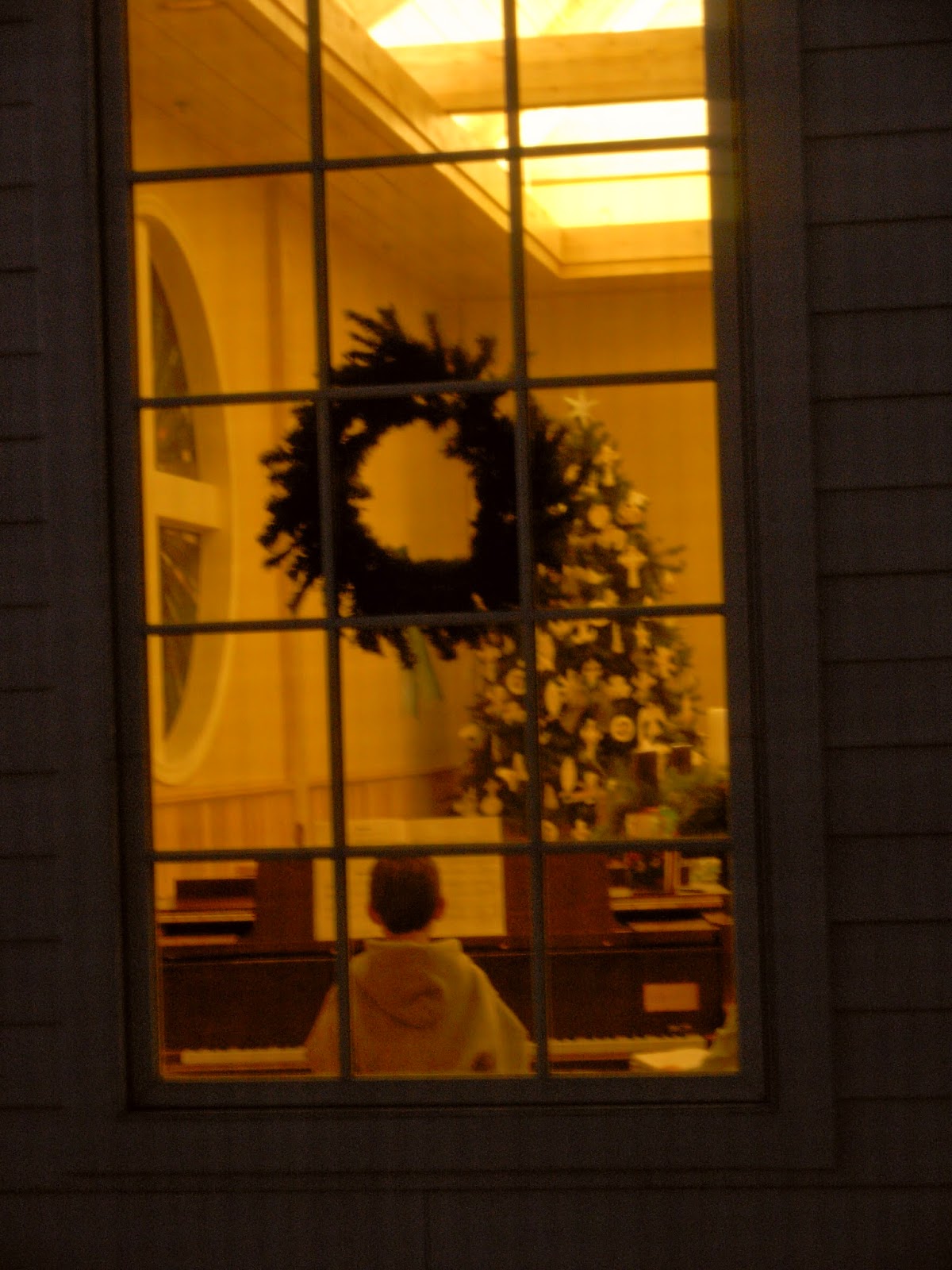

A quaint New England church
Steeple rising
Bell ringing
People gathering
Greeting each other
The sanctuary filled with worshipers
    wrapped in warm clothing
Candles flickering
Choirs singing
Young people reading
    the ancient story once more…
Sumptuous music
    filling the airways
Rudolph, Frosty, and Bing's White Christmas
Renaissance songs and medieval chant
Drummer boys and Calypso beats
Bells ringing and coins clanging in kettles
Carolers singing to homebound friends
Marimba, cello, violin, solo, choir and organ
All of this is Christmas.

Telephone conversations with friends
    and family far away
Notes and cards and Christmas letters
Messages and photos text-ed
Status-es, links and videos post-ed
Tweets and sweets abounding
So connected now
So many friends
   (some I never met)
So much goodwill
This, too, is it Christmas.
Children underfoot
    Impatient, eager and filled with expectation
Memories too of my children when they were children
And my childhood too
Cookies and milk for Santa
The Lionel train that whistled beneath the tree
    endlessly blowing smoke over the lighted houses of Plastic-ville
Grandmothers and grandfathers
    uncles aunts and cousins
    so many that Christmas always took two weeks
Mother and Dad now gone
Cousins too,
 so far away in miles and years and memories

And this is Christmas.
Elegant and primitive nativity scenes
And living ones too -
 Outside, in winter,
 With smelly mules and sheep and cows in dirty straw
 Mannequin angels suspended overhead
Joseph and Mary and the shepherds
   and wise men shivering in the cold
The plastic baby Jesus wrapped in beautiful rags
   and uttering not a sound

Perhaps here is the meaning of Christmas.
Or does it have to do with
Soldiers in barracks and foxholes
In planes above
In submarines below
In outposts and command centers
and hospitals too,
And their families anxious or proud
 waiting for their safe return
And some families, grieving
And some soldiers learning to walk again
And some without sight or hearing
And some with other disabilities

And villagers too, and city dwellers
    In Iraq, Syria and Afghanistan
    Egypt,  Somalia and Nigeria
    Jerusalem, Ramallah and Mogadishu
    Ferguson, and south Chicago too
Caught in endless crossfire
    Hands up, don't shoot
Homes and neighborhoods destroyed
livelihoods threatened
Fearful of strangers
Fearful of neighbors
Fearful even of us

Is this Christmas?
Children in Liberia,
    orphaned, fending for themselves
Young men and women in Juarez and Medellín 
But also DesPlaines, Arlington Heights
    and Barrington
 Trying to free themselves
    from unspeakable burdens
People sleeping in the hallways of O’Hare
Sharing the meager food they possess
Beggars hawking newspapers at Olgvie,
at the corner of Madison and State
Hustlers and hopeless behind prison bars
    and those imprisoned by their addictions.

What is Christmas for them?
Firefighters, police officers and rescue workers
    living with the disabilities of their heroic deeds
Firefighters, security personnel, pilots,
Diplomats, aid workers and healthcare providers
    paramedics, physicians and nurses
    and so many more
    on duty this very night
    away from home, away from family
    so that home and family
and others will be safe.

Where is their Christmas celebration?
Is it the recollection of a birth,
    even a sacred birth,
    2,000 years ago?
Is it the celebration of a promise made
     when the world was fresh
with possibilities?
Did it take place long ago
    in a little town called Bethlehem
    to Mary and Joseph, to shepherds, magi and angels?
   (And to Herod, Pilate and and other less savory characters?)

Was Christmas then, or is it now?
Did it happen long ago?
May it happen tonight?
Is this a moment in sacred time?
Will it give birth to us?

What is Christmas?

Christmas is a sacred opening
    through which God births each of us
    and names our ancient destiny:

With Mary, we are called to be God-bearers
    in our world today.
With Joseph we are called to protect
    all that is holy and fragile.
With the shepherds we are invited to bow low
    before the wonder of the commonplace.
With the magi we are summoned to follow faithfully,
     trusting God to lead us aright.
With the angels we are called to herald good news
of great love for the earth and everything upon it.
With all the inhabitants of ancient Bethlehem
     we are summoned to join
     the poor, the meek, and those who grieve,
     to take our places among
     those who hunger and thirst for righteousness,
     and those who simply hunger and thirst,
     those who are merciful and pure in heart,
     and those who work for peace upon the earth.

This is Christmas:
When we hear the summons,
when we answer the call,
when God’s spirit comes upon us,
when Christ’s truth becomes our truth,
when God’s love flows through us without inhibition.
Then we will know the meaning of this night.
Then we will see even in ourselves this babe in Bethlehem:
    A lowly Child whom the ages call 
    Wonderful Counselor, 
    Prince of Peace.
    
This, I believe, is Christmas.


Wednesday, April 2, 2014

Easter Below Zero

It was five degrees below zero - Celsius! - as we made our way to the Cathedral. I was a guest of the mayor of Novosibirsk, the third largest city of the Soviet Union and the capital of Siberia. The all-night vigil was beginning. Falling snow was packed hard underfoot by thousands of Russians who, like me, had come to worship and welcome Easter’s dawning. Many carried torches and chanted great Orthodox hymns. They formed a huge mass of devotion that swirled reverently around that ancient building all through the night. Later, when I was comfortably seated in the center of the second balcony, I heard their chanting; it flowed into the rich liturgy unfolding around me. The church’s interior also was jammed with devotees who were crowded together, shoulder to shoulder. Many carried lighted tapers as they swarmed below amidst radiant icons and thickening clouds of incense.

It was April 1-2, 1990. The USSR was imploding. The country was in the throes of economic collapse. Shelves were bare. Jobs were scarce. During the day, these same Russians stood for hours in long lines and sub-zero temperatures to get even a little food. Their government was reeling from the aftermath of Chernobyl, and reaping the consequences of decades of deceit and broken promises.


Their world was falling apart. They lived Lent – not by “giving up chocolate”, but by enduring betrayal, suffering, and the death of everything they knew. Now they gathered expectantly at the cathedral. Though the night was long and dark and very cold, something new was afoot. When the sun peaked over the horizon and into the cavernous church, a loud cry went up, “Christos voskrese!” and it was answered by a thunderous “Voistinu voskrese!” from every direction. “Christ is risen!” “He is risen, indeed!”


Perhaps our own prolonged and bitter winter, the economic difficulties faced by so many of us, and the stressful news from all sides, bring these memories to my mind now. Like our Siberian counterparts, we too need a spirituality that empowers us to live confidently in the midst of troubled circumstances. We too seek a way that touches our hearts, honors our intellects, and emboldens us to live conscientious lives. We too want to believe.


“Christ is risen!” “He is risen, indeed!” My Russian friends were not mouthing meaningless religious platitudes to celebrate a cultural holiday. They were not arguing historical fact or fiction. They were making a heartfelt affirmation. Their backs were against the wall, but they believed – or wanted to believe - that life is stronger than death, and that goodness will ultimately triumph. They were choosing hope over despair, and faithfulness over bleak futures or empty lives.


This, finally, is why we worship on Easter. In the midst of the lives we live, we want to know redemption and resurrection. We want to experience real life and genuine hope, and the deep joy of a meaningful life.


Let us give thanks for the return of spring and longer days, for birds and blooming flowers. But most of all, let us join together to give thanks to the Lord of Life itself, and for God’s continuing and transforming presence in all circumstances.

Thursday, March 28, 2013

Meditation on Holy Week


  At one time or another, most of us have faced challenges that we didn’t see coming: the pink slip at work, the moment when our Romeo or Juliet turned into Attila the Hun or Cruella de Ville. For some, it might have been that fraction of a second when we lost control of the car, or those endless months when the family was hungry and we had no money. For others, it might have been the day we realized that alcohol had taken control of our lives and was taking us down a road of fear and loss. A sobering medical diagnosis, the betrayal by a friend, a door slammed in our face – all these and more turn our world upside down.
  It is precisely in these moments that we need to return to the fundamental story of our faith. During Holy Week, we walk with Jesus through his experience of loss, betrayal, rejection and even death, and we find that his story and ours intersect. Our suffering is caught up in his. Our own situations become part of a much larger story, a story of hope and affirmation.
“Let him easter in us, be a dayspring to the dimness of us…”  So wrote Gerald Manley Hopkins. 
  Holy Week does not end at the cross or the tomb. It carries us through the darkest night of the soul into an inconceivably brilliant dawn. Holy Week leads through darkness to the truest source of our strength for today, and renews our hope for tomorrow. Easter is not simply an event to be recalled, but a truth to be celebrated. When we feel closed down, hemmed in, tied up, and unable to function, Easter breaks through with a glorious affirmation.  I invite you to let him “easter” in you, and to brighten whatever darkness you may know. 

Thursday, September 8, 2011

Tears are the highest form of prayer…thoughts for September 11, 2011

                                     There’s a feeling inside
                                     That stirs our madness
                                     To have chosen life
                                     In the fields of sadness

(Trail of Tears, Anonymous, Cherokee)

The calamity of September 11 is still too big for our minds to encompass, and too deep for our hearts to fathom. It is remarkable not because of the number of lives lost or the cunning of the attackers. Tragically, far larger numbers have perished in other settings, and humankind has never lacked for ingenuity in the methods of destruction. “9-11” irrevocably altered our perceptions of humankind, good and evil, religion, and life itself. Particularly at the World Trade Center in New York City on that fateful day, the vertical dimension of human hope intersected with the horizontal plain of human reality.

Those twin towers had burrowed deeply into the earth even as they reached imposingly into the sky. They rose up from the ground of our past. They pointed to a vision for our future. They embodied an audacious modernity—technologically, economically, aesthetically, and spirituality. They pointed to an organizing principle for a whole civilization—not conquest, beauty or mystery, but trade.

But buried beneath them lay another important part of our history. On September 11, 1609 Henry Hudson “discovered” Manhattan Island for an expansive European civilization. Hudson’s arrival was the beginning of a succession of immigrations that changed the island forever. The children of the children of these immigrants dug deeply into this earth, and raised shimmering towers into the sky.

More than 550 generations across twelve millennia have inhabited the same land on which the World Trade Center stood. For those “First Nations” people, the arrival of European explorers would prove more disastrous than this more recent tragedy. In the fifty years that followed Hudson’s arrival, the population of the Metoac people alone fell from 10,000 to less than 500 due to the combined effects of warfare and epidemics. “Native peoples of the Americas have lived on intimate terms with the shadow of terrorism,” wrote Tia Oros (Zuni) in The Burning Sky. Terrorism “has fed on us with a ravenous appetite for our peoples and our lands for centuries…”

If the vertical dimension is embedded deeply in the soil of our history, it also rises into the stratosphere of our expectations. The WTC embodied the vision of a world that is radically interdependent and interconnected, and a world at peace. It was the progressive and secular dream of advancing prosperity and increasing affluence worldwide. Expanding trade, driven by accelerating flows of information, capital, technology and other resources, would create new norms. New institutions, uninhibited by the values of long-established cultures, would improve the quality of life and increase opportunities for everyone.

This dream of global trade and increasing affluence was present in an embryonic form even in Hudson’s 1609 trade mission financed by Dutch merchants. It has been an engine of incredible material improvement worldwide. It is transforming every corner of the world and raising expectations of people everywhere. But sadly, not everyone has benefited. Many are left on the sidelines. The pursuit of this dream has been accompanied by genocide, slavery, exploitation and the impairment of the biosphere itself.

There are spiritual lessons to be learned on this 10th anniversary of the attacks. The attacks may have germinated in perpetually festering grievances, but they were carried to fruition in the name of God and carried the apparent sanction of a segment of organized religion. With Henrietta Mann, a Montana professor, Cheyenne elder and herself a descendent of a brutalized people, we struggle to understand "how anyone could be so diabolical to strategize and plan for such wholesale destruction.” The world’s religious communities must engage in the deepest soul searching. We cannot simply disclaim terrorism and violence as “distortions” or “abuses” of otherwise genuinely religious impulses. We must identify the pathology of violence for what it is, and purge those things in our respective traditions that contribute to the world’s stockpile of hatred. The greatest tragedy for us will be if we become more vengeful, mean-spirited and small-minded, if we lose touch with our compassionate souls.

“The terrorists themselves had lost hold of the greater spirituality within life long before they killed themselves and many others,” wrote Rebecca Adamson (Cherokee), the founder of First Nations Development Institute. “From this time forward we must cultivate a more profound understanding of the sacred." This will be humankind’s greatest counterweight to evil deeds and endless violence.

To the indigenous peoples who were displaced, the very ground on which the WTC was built has been hallowed anew by the more recent tragedy. “All earth is sacred, but perhaps among the most sacred ground in the United States is the site of the former World Trade Center,” said Ms. Mann. Encouraged by tribes across the continent, she and Arvol Looking Horse, Pipe Carrier for the Lakota Nation, were the first to perform rituals and prayers at the site of the devastation. Mann prayed for the healing of the earth, and for the people working in the pit. “I prayed for the great-grandchildren of our great-grandchildren, that they will never experience a tragedy of this kind…I cried during the ceremony. Tears are the highest form of prayer.”

The Apostle Paul once wrote, "Owe no one anything, except to love one another; for the one who loves another has fulfilled the law. The commandments… are summed up in these words, 'Love your neighbor as yourself.'” (Romans 13:8-10) From a First Nations perspective, love begins in the simple acknowledgment that “We are all related.”

Love repents when repentance is called for. Love seeks reconciliation rather than retaliation. Love seeks the higher path of justice for all parties in conflict. If a resort to arms cannot be avoided, love proceeds with reluctance and anguish, always trying to find a peaceful alternative.

In the Cherokee poem, Trail of Tears, it is said that “a broken heart beats like a funeral drum.” Today let us hear the world’s broken heart. Let us respond to our own pain and grief, and to the fear and sorrow in the world, by affirming our sacred connections to all.